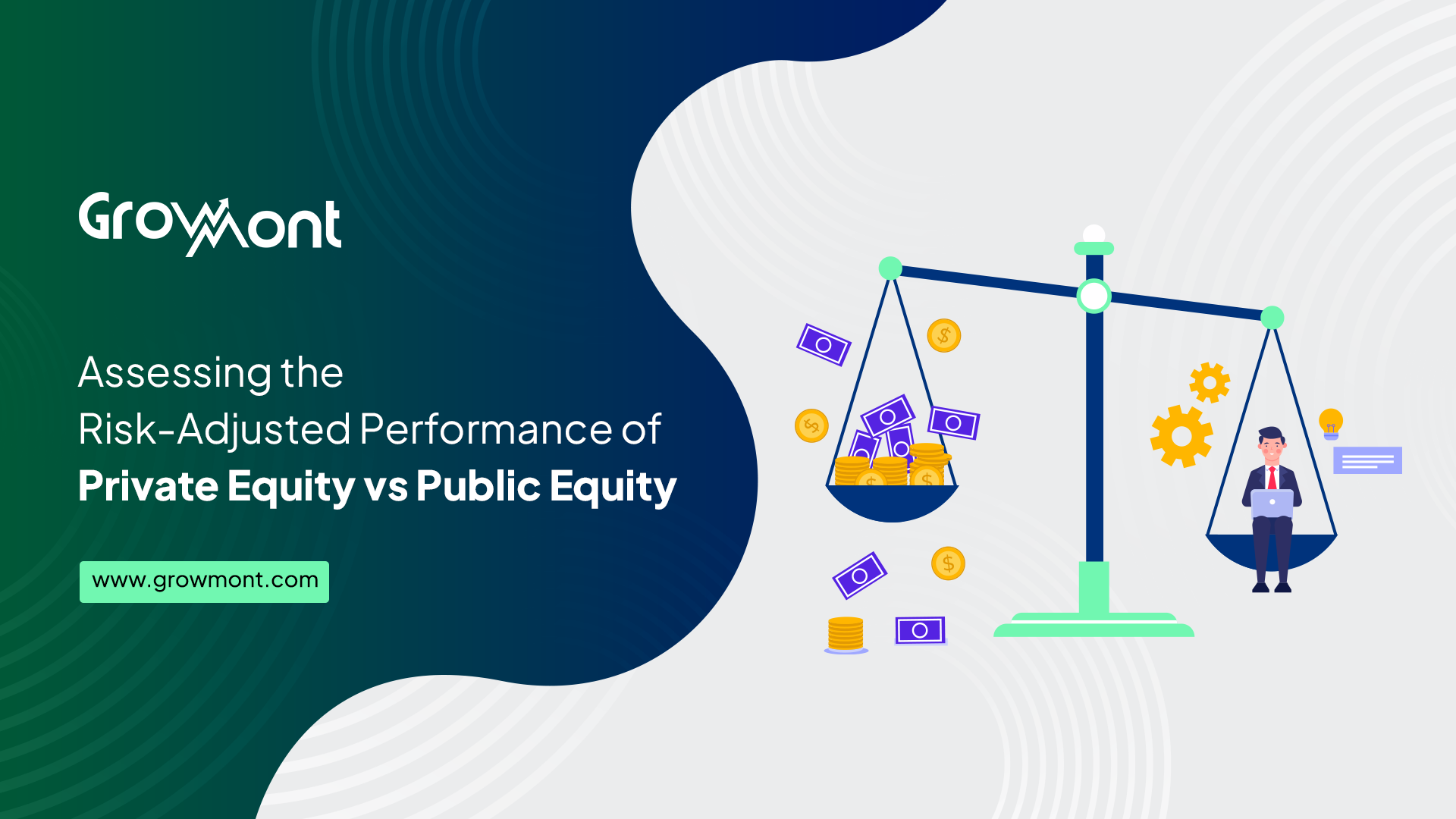
Not all returns are created equal. Especially when risk, liquidity, and access vary significantly.
For high-net-worth individuals, family offices, and institutional investors, the promise of high returns often leads to the inevitable question: Is private equity really outperforming public markets—or are we just not measuring it correctly?
At Growmont, this question sits at the core of many investment conversations. And there’s no simple answer to this.. As comparing private equity investment with public equity returns requires more than headline IRRs. It demands an analysis of
- Risk-adjusted performance,
- Liquidity limitations
- Volatility adaptation and
- Long-term value creation.
Why Compare the Two in the First Place?
Public equities offer liquidity, transparency, and accessibility. Investors can buy or sell within seconds. Prices updates in real time, regulation is mature, and performance data is readily available.
Private equity, on the other hand, offers access to early-stage value creation—unlisted companies, turnarounds, and strategic growth capital—but with longer lock-in periods, less liquidity, and limited transparency.
Yet, more High-Net-Individuals and institutions are allocating substantial capital to private market investments. Why? Because when constructed thoughtfully, these investments deliver not just higher absolute returns, but potentially better risk-adjusted ones over the long term.
What Is Risk-Adjusted Performance—and Why Does It Matter?
Raw returns can be misleading. An investment yielding 18% annually sounds attractive—until you realise it comes with extreme volatility or high downside risk. Risk-adjusted performance measures how much return you’re getting per unit of risk taken.
Key metrics include:
- Sharpe Ratio – Compares excess return (over the risk-free rate) to volatility
- Sortino Ratio – Focuses only on downside risk, arguably more relevant for illiquid assets
- Alpha – Measures performance relative to a benchmark, adjusting for market movements
- Volatility – Captures the unpredictability of returns over time
When you’re managing large sums of wealth, consistency, predictability, and resilience start to matter more than occasional outperformance.
Private Equity Investment: Lower Volatility or Hidden Volatility?
One of the most commonly cited advantages of private equity investment is its lower observed volatility. In private equity, valuations are not marked to market daily— instead updated quarterly or at fund audit intervals—returns appear smoother than their public counterparts.
But this raises a critical question: is private equity less volatile, or does it just look that way?
In reality, the underlying businesses may be equally exposed to macro cycles. However, the absence of daily pricing protects investors from reacting impulsively, avoiding the behavioural risks associated with public markets. This can actually work in the investor’s favour—ensuring they stay committed to long-term strategies instead of reacting to short-term noise.
Of course, risk doesn’t disappear—especially around
- Liquidity constraints,
- Default risk in leveraged buyouts, and
- Execution risk in growth-stage capital.
But these risks are idiosyncratic and less correlated with market beta, which, in a diversified portfolio, can enhance overall performance.
A Real Look at Return Patterns
Multiple studies–including data from Cambridge Associates and Bain & Co., have shown that top-quartile private equity funds consistently outperform public market equivalents (PMEs) over 10–15 year periods.
However, this outperformance is heavily concentrated. The dispersion between top and bottom quartile funds is significantly wider in private equity than in public equity. This means manager selection is critical.
At Growmont, we view private market investments not as broad categories, but treat them as curated entry points into specific return-generating strategies. We assess funds not just on past IRRs but on process, team continuity, exit discipline, and alignment of interests.
We also adjust for risk—scrutinising leverage levels, time-to-exit assumptions, and capital deployment speed—before projecting long-term return profiles.
Private Equity in Portfolios: A Risk Mitigator or Amplifier?
Contrary to common perception, private equity investments—when properly selected—can reduce portfolio risk. Here’s how:
- Low correlation to public markets helps buffer drawdowns during equity market crashes
- Diversified drivers of return, such as operational improvement or multiple arbitrage, reduce reliance on market timing
- Behavioural insulation (i.e., illiquidity) limits panic-selling and short-term adjustments
But it comes with its own set of challenges:
- Illiquidity – You can’t exit at will. Capital is typically locked for 5–10 years, requiring a long-term commitment.
- Blind pools – Investors often commit capital without knowing about the allocation.
- J-curve effect – Returns may dip in the early years before they rise as funds spend initial years deploying capital.
Hence, allocation sizing, fund selection, and exit planning become essential considerations. Private equity is not a replacement for public markets—but a complementary source of long-term alpha.
The Growmont View: Risk-Adjusted, Not Risk-Blind
At Growmont, we treat private equity not as a fashionable asset class but as a strategic tool for long-term wealth structuring.
That means:
- Filtering managers based on actual risk-adjusted outcomes, not glossy decks
- Constructing private equity exposure to complement public market holdings, not duplicate them
- Stress-testing portfolios to simulate liquidity crunches, exit delays, and capital call mismatches
- And most importantly, educating clients on the full cycle—from capital commitment to exit monetisation
Our goal is not just to maximise returns—but to optimise it relative to the complexity and commitment investors are taking on.
Conclusion: In a World of Uncertainty, Smart Illiquidity Pays
For High Net-Worth-Individuals and institutions seeking stability, long-term alpha, and lower correlation to market shocks, private market investments offer a compelling opportunity. But like all investments, they must be understood, modelled, and managed with care.
Returns only matter when measured against the risk taken to achieve them.
At Growmont, we apply a structured, research-driven lens to private equity investment—one that’s designed to deliver sustainable outperformance without overexposing you to hidden dangers.
If you’re looking to balance long-term growth with intelligent risk management, our advisory framework is built for precisely that.